

Fake data generator
Fake data that holds together.
A fake data generator like a random-value library gives you believable names, emails and addresses one field at a time. Misata generates whole fake datasets: several tables whose keys join, numbers that follow the distributions you set, and declared figures such as a 2% fraud rate or a revenue total that come out exact. Every dataset is checked before you get it.
What usually goes wrong
Fake data stands in for real data wherever real data cannot go: a demo, a test, a course, a public notebook.
Field-by-field randomness
Each value looks fine; together they are wrong. A customer signs up after their first order, a refund exceeds its payment.
Rates you cannot control
A fraud flag set at random lands at 1.7% one run and 2.4% the next.
Writing the glue yourself
Loops, lookups and key maps that turn into a project of their own.
What you get instead
Relationships first
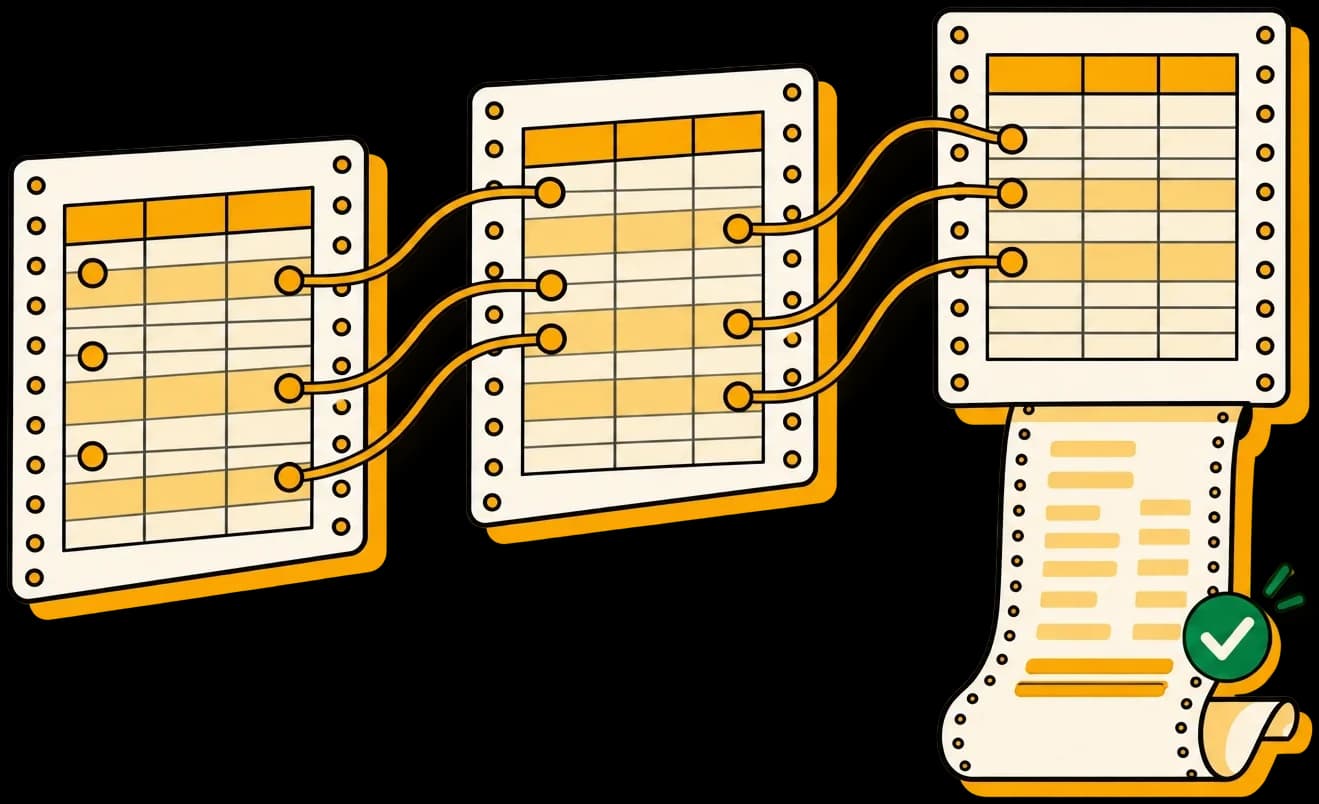
Tables are generated in dependency order, so every reference points at a row that exists.
Exact where you ask
Declared counts, rates and totals are hit exactly and recomputed on the delivered rows.
No glue code
Describe it in a sentence, or hand your AI assistant the job through the MCP server.
A request that works
Card transactions for 2,000 customers over six months, with exactly 2% labelled fraud, fraud clustered at night and on new devices.
Four ways to get it
In your browser
Describe it in Misata Studio, shape it, and export. Two complete builds a month are free.
Try this promptFrom your AI assistant
Connect the MCP server to Claude, Cursor or VS Code and ask. No key needed to start.
Connect the MCP serverDownload one now
Twelve free multi-table sample databases, and premium ones with the ground truth inside.
Browse datasetsIn Python
The open-source library: pip install misata, MIT licensed, runs offline.
Read the docsHow the approaches compare
| Random-value library | Form-based generator | Asking a chatbot for rows | Misata | |
|---|---|---|---|---|
| Realistic single values (names, emails, addresses) | ||||
| Several tables whose keys always join | ||||
| Declared totals and rates come out exact | ||||
| Same rows every run (seeded) | ||||
| Shows a check of what it produced | ||||
| No code needed |
General approaches, not specific products; individual tools vary. A dash means some tools do it, or it takes work.
Questions
How is this different from Faker?
Faker and similar libraries generate individual values: a name, an email, a date. They are excellent at that and Misata does not replace them for single fields. Misata works a level up: whole datasets across several tables, with the keys, the ordering of events and the declared numbers guaranteed and checked.
Can I generate fake data with AI?
Yes, and the safest way is to let the model design the tables and let a deterministic engine make the rows. Asking a chatbot for rows directly tends to produce keys that do not resolve and totals that do not add up past a few dozen rows. Misata's MCP server lets Claude, Cursor or VS Code design the schema while the engine guarantees the math.
Is any of it real data?
No. Every row is generated from a specification. Nothing is copied from, sampled from or trained on a real dataset, so there is no personal data in it and nothing to scrub.
Is it free?
The twelve sample databases are free to download with no signup, under CC0. Misata Studio gives every account 20 credits a month, which is two complete builds, with no card. The MCP server needs no key or account for datasets the assistant designs itself, and the Python library is open source under MIT.